Salt in the kitchen: fleur de sel, grey salt, pink salt and flavoured salts
Origins, uses and buying tips from a fine food house founded in 1921 in the Basque Country and awarded at the 2026 Concours Général Agricole.


Une alliance parfaite entre l'ail et le piment qui donnera vie à vos plats avec une intensité envoûtante.
Our exceptional Albert Ménès salts are real little jewels with bright colours and original flavours.
Let yourself be tempted by our quality seafood, carefully selected for you.
A real alternative to traditional spices, these accompaniments will enhance the flavour of your favourite dishes.
Since 1921, Albert Ménès has been pursuing the beautiful adventure of taste with greed and generosity.

Origins, uses and buying tips from a fine food house founded in 1921 in the Basque Country and awarded at the 2026 Concours Général Agricole.
Salt goes into almost every recipe, yet its varieties are not used the same way. A salt hand-harvested in the Guérande salt marshes, a rock salt mined in Pakistan and a salt blended with AOP Espelette pepper differ in texture, in moisture and in how they are used in cooking. This guide covers their origins and uses. It also gives practical pointers for choosing them, measuring the right amount and storing them properly at home.
Fine crystals that form on the surface of salt-marsh ponds in hot, windy weather and are skimmed off by hand. Fleur de sel accounts for only a few percent of a salt worker's harvest. Its crunch is best added just before serving, never during cooking.
Harvested from the bottom of the ponds, in contact with the clay that gives it its colour, grey salt stays moist and contains magnesium. Guérande salt has held a PGI since 2012. Use it for cooking water, salt crusts and brines.
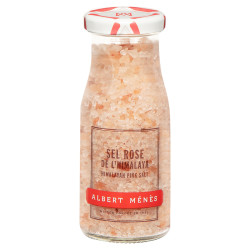
A rock salt mined mainly at Khewra, in Pakistan's Salt Range. Its colour comes from trace amounts of iron oxide. Made up of 95 to 98% sodium chloride, it is used in a grinder or as a block for searing.
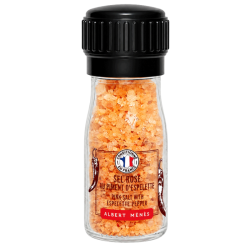
Fleur de sel or fine salt combined with herbs, spices, citrus or seaweed. In the Basque Country, the blend with AOP Espelette pepper is the most common. The ingredient list gives the share of each flavouring and shows whether it is the real ingredient or a flavouring.
Both come from the same marsh. Fleur de sel crystallises on the surface and stays white and dry. Grey salt settles on the bottom of the pond, in contact with the clay, which makes it moister and coarser.
Its minerals are present in amounts too small to have any effect at normal intake. The WHO recommends no more than 5 g of salt per day, about one teaspoon, whatever the variety.
No. EU Regulation 1169/2011 exempts cooking salt from a best-before date. Only flavoured salts carry one, because of their added ingredients.
Yes, as long as the grinder has a ceramic mechanism, because the moisture in grey salt corrodes metal. If it clumps, dry it for 10 minutes in the oven at 100 °C before filling the grinder.